About Me
I’m an inventor, designer and maker. My projects usually start with an idea, and I’m fascinated by the challenge of finding a way to express that idea. Often that means inventing a new way of making something, experimenting with unfamiliar materials, or finding people and processes that can help bring the idea to life.
My first career was as a chartered civil engineer, followed by more than two decades in journalism and internet publishing. Those careers left me with a strong problem-solving instinct. I enjoy understanding how things work, finding solutions and, particularly, tackling the interesting problems that arise when an idea meets reality.
Making has always been part of my life, including making art. When I retired in 2007 and moved to my present home, I had an extension built specifically as a studio because I wanted to make art. I asked the art director of the internet publishing company I had co-founded whether I should study art formally. His advice was to take evening classes instead: if what I wanted was to make art myself, there was little point in making a big thing of studying art.
So I did a lot of evening classes. Then I discovered that Plymouth College of Art offered one in glass and enrolled. I quickly realised that PCA was rather different from most universities: the emphasis was firmly on making, with an extraordinary range of workshops, equipment and facilities. I loved it. What began as an evening glass class eventually led me to enrol for a degree in Contemporary Craft, which I completed with First-Class Honours in 2018. My degree project, The Snake Pit, was selected as a “Pick of the Show” at the London Design Fair.
I’m interested not just in what I make, but in finding the right way to express an idea. The process of working that out can become as important — and sometimes as enjoyable — as the finished work. I rarely begin by choosing a material. Usually there is an idea first, and I follow it to see what materials and processes might make it possible. The idea leads to a problem; the problem leads to experimentation; and the experimentation often leads somewhere I hadn’t anticipated.
My Teapotty project was an extreme version of this approach. I challenged myself to make the same everyday object — a teapot — repeatedly from completely unsuitable materials, including nails, cocktail sticks, tea leaves, chocolate and wool. Each material forced me to invent a new making process through trial and error. It was the process of figuring out how to realise each idea that fascinated me.
That is why this website documents not just finished objects but the experiments, failures, discoveries and solutions behind them. For me, the finished object is evidence that the process worked. What really interests me is figuring out how an idea can become something tangible.
Increasingly, though, I’ve discovered that I enjoy making things happen as much as making things myself.
United by the Sea, a major community art project in Looe, is a good example. Running past the Lower Quay Stores, I saw its 60-metre-long white wall and thought: What a great site for a mural. I initially imagined a painted mural.
Then came the suggestion that local schools should be involved. I couldn’t initially see how that would work without losing control of the design. But when I met the head of art at one of the schools, she suggested ceramic fish: children could make individual fish while we retained control of the overall design. That changed the idea completely.
From there, the project became a succession of problems to solve: preparing clay for hundreds of children, firing and glazing hundreds of individual fish, organising volunteers and working out how to install the finished pieces on the wall. I bought and refurbished a kiln, developed the processes needed to handle the project at scale, and recruited and coordinated more than 30 local volunteers who helped with the glazing. Four local schools have contributed hundreds of fish. The fish are now made, and the next stage is to install them as a huge community artwork on the Lower Quay Stores.
The project has made me recognise that orchestrating is an important part of what I do. I enjoy working out how an ambitious idea can actually happen — what needs to be made, what processes need to be devised, what problems need solving, and who needs to be involved. Getting hundreds of children and dozens of volunteers to contribute to a single artwork is, in its own way, another kind of making.
I don’t think of myself as a ceramicist, glass artist, metalworker or any other kind of material specialist. I start with an idea and see where it leads. I’m interested in what a material can be made to do, and in finding the people, processes and techniques that will make an idea possible.
So although I describe myself as an inventor, designer and maker, those words only tell part of the story.
I like figuring things out. I like making things. And increasingly, I like making things happen.
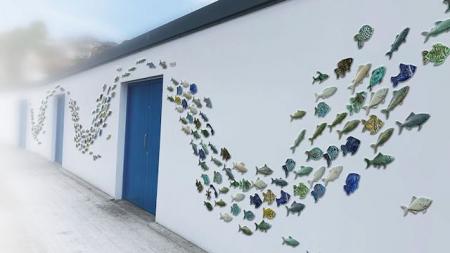
Mockup of the proposed United by the Sea mural comprising hundreds of ceramic fish made by local schoolchildren
CV Peter Heywood September 2026